Total Pageviews

Tuesday, 4 December 2012

79 RITCHIE’S FABULAE FACILES TRANSLATION THE ARGONAUTS 79 - A FATAL GIFT

THE ARGONAUTS 79. - A FATAL GIFT


This picture from Wikimedia Commons is of the Medea Sarcophagus (in the Altes museum in Berlin). Wiki also provide the following description from left to right of the picture:
Medea sends her two sons to deliver a golden wreath and a precious garment to Glauce, the betrothed of Medea's former lover Jason, depicted on the left.
The garment, which was poisoned, catches fire and burns Glauce alive. Her father, king Creon, is standing next to her.
Medea is about to murder her two sons, who are still playing in front of her.
Medea enters a chariot driven by dragons. She takes the bodies of her dead children with her.

Isn’t it fantastic! Sorry if I have given away more of the story than you would have liked, but I think it is such a great picture and I just had to share it with you!
a) Iásón et Médéa é Thessaliá expulsí ad urbem Corinthum vénérunt, cúius urbis Creón quídam régnum tum obtinébat. Erat autem Creontí fília úna, nómine Glaucé. Quam cum vídisset, Iásón cónstituit Médéae uxórí suae núntium mittere eó cónsilió, ut Glaucén in mátrimónium dúceret. At Médéa ubi intelléxit quae ille in animó habéret, írá graviter commóta iúre iúrandó cónfírmávit sé tantam iniúriam ultúram. Hóc igitur cónsilium cépit. Vestem parávit summá arte textam et variís colóribus ínfectam; hanc mortiferó quódam venénó tinxit, cúius vís tális erat ut sí quis eam vestem induisset, corpus éius quasi ígní úrerétur. Hóc factó vestem ad Glaucén mísit; illa autem nihil malí suspicáns dónum libenter accépit, et vestem novam móre féminárum statim induit.

 b)
Some words have been chosen for special consideration and are listed below. For the words not included in this list please refer to the WORDLIST in PAGES TOP RIGHT SIDE BAR. If you need help with points of grammar raised in today's excerpt, consult ESSENTIAL GRAMMAR NOTES also top right side bar.

e – preposition ‘from’ followed by ablative case.
expulsi – perfect past participle ‘having been expelled/thrown out’
ad – preposition ‘towards’ followed by accusative case.
venerunt – third person plural perfect of venire.
cuius urbis – genitive of feminine relative adjective (qui quae quod), agreeing with genitive of third declension feminine noun urbs, urbis meaning therefore ‘of which town’.
Creon quidam – Creon, the name of the ruler (you will notice that names usually come first in this kind of phrase) followed by the indefinite adjective quidam ‘a certain’, together therefore ‘a certain Creon’,
regnum tum obtinebat – Literally, ‘the royal power/kingdom – at that time – was holding (imperfect singular of obtinere)’ but perhaps the meaning is better grasped ‘was ruling at that time’.
Erat autem Creonti – Literally, there was –now/however – to Creon (dative) meaning ‘Creon had’ . The verb sum with a dative noun or pronoun is often used to express possession ‘est mihi = I have; cui erant = to which there were = which had (see Hercules second labour).
nomine – ablative ‘by name’, or as we would probably say ‘called’.
Quam cum vidisset – quam is here what is sometimes called a connecting relative. This means that it connects this sentence to the one before as quam refers to Creon’s daughter who has just been mentioned. Literally it is ‘whom when he had seen’ but we would probably say something like ‘when he saw her, Jason etc’.
nuntium – a message, notice, announcement; in this context it means a notice of divorce, which given the circumstances seems somewhat harsh, don’t you think?.
ut Glaucen in matrimonium duceret – a purpose clause after ut takes the verb in the subjunctive ‘to marry Glauce’. Ducere came to mean marry, because the bridegroom led his bride in a wedding procession to his own home so it can only be used of a man; when a woman marries the word used is nubere (to put on a veil) and can only be used of a woman.
quae in animo haberet – Literally, what (things) he was having  (subjunctive) in his mind better understood by ‘what he intended’.
confirmavit – confirmare can mean to confirm, strenthen, and to assert positively, declare, or pledge.
jure jurandum – ablative of jusjurandum, oath, which is often written separately, as here, means ‘by an oath’.
ulturam – as often happens with the future infinitive in the accusative and infinitive construction esse is omitted. We have the accusative and infinitive as this is another example of reported speech, or indirect discourse if you prefer, she pledged that  etc.; her words were ‘I will be avenged’ being reported as ‘she said she would be avenged’.
mortifero quodam veneno - ablative phrase, notice the word order; literally 'with a deadly certain poison' which we would probably express as 'with a certain deadly poison'. Don't forget that Latin often employs a different word order from what we are used to, but we can usually tell which words belong together by their case and number.
ut si quis ... induisset – ‘such that if someone (quis is the indefinite pronoun) should put it on’.
quasi igni ureretur – literally, as if with fire (ablative of the third declension noun ignis ignis) he/she/it was being burned (third person singular imperfect passive subjunctive of uro, urere).  Notice that ignis is one of the third declension nouns that take i in the ablative singular (not e).  We have here the imperfect subjunctive as quasi introduces an imagined comparison.
nihil mali – literally, nothing of bad, this is the partitive genitive and is often to be found after a word indicating a quantity or amount of something (compare plus cibi – ‘more food’, literally ‘more of food’.; we would say ‘nothing bad.’
more feminarum – ablative of mos custom, in the way of, as is the custom of followed by the genitive plural of femina ‘as is the custom of women’.
c)
Note: This section is not translated into idiomatic English but is intended, together with the notes, to give you the gist of the meaning; you can then come up with your own improved translation. Lines marked with an * in particular need to be reworked to sound like proper English.
Iason et Medea e Thessalia expulsi
After Jason and Medea were expelled from Thessaly
ad urbem Corinthum venerunt,
the came to the city of Corinth,
cuius urbis Creon quidam
(of) which city a certain Creon
regnum tum obtinebat.
at that time was ruling.
Erat autem Creonti filia una,
Now Creon had a daughter,
nomine Glauce.
called Glauce.
Quam cum vidisset,
When he had seen her,
Iason constituit Medeae uxori suae
Jason decided to his wife Medea*
nuntium mittere
a notice of divorce to send*
eo consilio,
of his decision,
ut Glaucen in matrimonium duceret.
to marry Glauce.
At Medea ubi intellexit
But Medea when she realised
quae ille in animo haberet,
what he intended
ira graviter commota
felt very angry
iure iurando confirmavit
and pledged on oath
se tantam iniuriam ulturam.
to avenge herself of such a great wrong.
Hoc igitur consilium cepit.
So she hatched this plot.
Vestem paravit summa arte textam
She prepared a garment woven with great skill
et variis coloribus infectam;
and of various colours dyed;*
hanc mortifero quodam veneno tinxit,
this she soaked with a certain deadly poison,
cuius vis talis erat
which was of such potency
ut si quis eam vestem induisset,
that when anyone put that garment on,
corpus eius quasi igni ureretur.
her body would seem as if consumed by fire.
Hoc facto vestem ad Glaucen misit;
When this was done she gave the garment to Glauce
illa autem nihil mali suspicans
She however suspecting nothing bad
donum libenter accepit,
accepted the gift gladly,
et vestem novam
and the new garment
more feminarum statim induit.
as is the custom with women, she put on at once.

d) The following section is for you to copy and compose your own translation.
Iason et Medea e Thessalia expulsi
ad urbem Corinthum venerunt,
cuius urbis Creon quidam
regnum tum obtinebat.
Erat autem Creonti filia una,
nomine Glauce.
Quam cum vidisset,
Iason constituit Medeae
uxori suae nuntium mittere eo consilio,
ut Glaucen in matrimonium duceret.
At Medea ubi intellexit
quae ille in animo haberet,
ira graviter commota
iure iurando confirmavit
se tantam iniuriam ulturam.
Hoc igitur consilium cepit.
Vestem paravit summa arte textam
et variis coloribus infectam;
hanc mortifero quodam veneno tinxit,
cuius vis talis erat
ut si quis eam vestem induisset,
corpus eius quasi igni ureretur.
Hoc facto vestem ad Glaucen misit;
illa autem nihil mali suspicans
donum libenter accepit,
et vestem novam
more feminarum statim induit.

Monday, 26 November 2012

78 RITCHIE’S FABULAE FACILES TRANSLATION – THE ARGONAUTS 78 – A DANGEROUS EXPERIMENT

THE ARGONAUTS 78 – A DANGEROUS EXPERIMENT

Audience update: Visitors to this page currently number over fifty thousand and have come from all corners of the globe:
Welcome!!!  to visitors from: Australia, Austria, Belgium, Bosnia and Herzegovina, Brazil, Canada, Chile, Colombia, Costa Rica, Czech Republic, Denmark, Estonia, Finland, France, Germany, Greece, Hong Kong, Iceland, India, Indonesia, Israel, Italy, Japan, Latvia, Kyrgyzstan, Luthuania, Malasia, Netherlands, New Zealand, Pakistan, Philippines, Portugal, Puerto Rico, Romania, Russia, Saudi Arabia, Singapore, Spain, Sweden, Switzerland, Thailand, Turkey, Uganda, Ukraine, United Arab Emirates, United Kingdom, and The United States!

This lovely picture of a relief of the Peliades and Medea is from Wiki Commons.

a)Dum fíliae régis hóc míráculum stupentés intuentur, Médéa ita locúta est: "Vidétis quantum valeat medicína. Vós igitur, sí vultis patrem vestrum in aduléscentiam redúcere, id quod fécí ipsae faciétis. Vós patris membra in vás conicite; ego herbás magicás praebébó." Quod ubi audítum est, fíliae régis cónsilium quod dedisset Médéa nón omittendum putávérunt. Patrem igitur Peliam necávérunt et membra éius in vás aéneum coniécérunt; nihil autem dubitábant quín hóc máximé eí prófutúrum esset. At rés omnínó aliter événit ac spéráverant, Médéa enim nón eásdem herbás dedit quibus ipsa úsa erat. Itaque postquam diú frústrá exspectávérunt, patrem suum ré vérá mortuum esse intelléxérunt. Hís rébus gestís Médéa sé cum coniuge suó régnum acceptúram esse spérábat; sed cívés cum intellegerent quó modó Peliás periisset, tantum scelus aegré tulérunt. Itaque Iásone et Médéá é régnó expulsís Acastum régem creávérunt.

 b)
Some words have been chosen for special consideration and are listed below. For the words not included in this list please refer to the WORDLIST in PAGES TOP RIGHT SIDE BAR. If you need help with points of grammar raised in today's excerpt, consult ESSENTIAL GRAMMAR NOTES also top right side bar.
dum ... intuentor – dum in Latin takes a present tense if it means while but can be translated by a past tense in English.
stupentes – present active participle as adjective agreeing with filiae, ‘astounded, stupified, amazed.’
intuentur – third person plural present tense of the deponent verb intueor, ‘look, gaze, regard, stare’ which looks passive but is active ‘they are looking’.
ita locuta est – literally ‘spoke thus’, locuta est being perfect of the deponent verb loquor which looks passive but is active, but we would probably say ‘said this’.
valeat – third person singular present active subjunctive of valeo, valere ‘be well, strong, powerful, effective etc.’
reducere – to bring back.
ipsae – you youselves.
facietis – second person plural future tense of the verb facio, facere, feci, factus, ‘you will do’.
conicite – second person plural imperative present tense of coniciere meaning therefore ‘throw’ (you plural – see Persons in Grammar Notes top right of sidebar).
vos conicite ... ego praebeo – you will have noticed that usually we do not use the personal pronouns (I, you, he etc) as the ending of the verb indicates who the person is but they are used for emphasis and contrast, as here, when the meaning is ‘You do this and I’ll do that’.
Quod ubi auditum est – literally ‘which when it was heard’. Quod is here called a connecting relative as it connects the sentence with the one before, we would probably say ‘when this was heard’.
putaverunt – third person plural perfect tense of putare, meaning therefore ‘they thought’ . Notice the word order – this sentence needs to be turned around to make any sense in English, we would probably say ‘the king’s daughters thought etc.
usa erat – 'she had used', third person singular pluperfect of utor, uti, usus sum, third conjugation deponent verb which takes the ablative case hence we have ‘quibus’.
re vera – really
his rebus gestis – ablative absolute, ‘when these things were done/accomplished/carried out’.
quod feci ipsae facietis – literally: quod – ‘that which’; feci – first person perf facere ‘I have done’; ipsae – yourselves; facietis - second person plural future of the verb facio, facere, feci, factus, ‘you will do’; the indicative future is sometimes used in the way of command (imperative).
aegre tulerunt – tulerunt is third person plural perfect of fero, ‘they took it badly’ or ‘they were very angry/vexed/indignant.
Acastum regem creaverunt -  notice the double accusative – ‘they made Acastus king.’
 
c)
Note: This section is not translated into idiomatic English but is intended, together with the notes, to give you the gist of the meaning; you can then come up with your own improved translation.
Dum filiae regis
While the king’s daughters
hoc miraculum stupentes intuentur,
observe this miracle amazed,
Medea ita locuta est:
Medea spoke thus:
"Videtis quantum valeat medicina.
You see how effective is the medicine.
Vos igitur, si vultis patrem vestrum
You therefore, if you want your father
in adulescentiam reducere,
to be brought back to youth,
id quod feci ipsae facietis.
that which I have done you youselves will do.
Vos patris membra in vas conicite;
Throw your father’s limbs in a pot;
ego herbas magicas praebebo."
I will supply the magical herbs."
Quod ubi auditum est,
When they heard this,
filiae regis consilium
the king’s daughters - the plan
quod dedisset Medea
which Medea had suggested
non omittendum putaverunt.
ought not to be disregarded  - they thought
Patrem igitur Peliam necaverunt
Therefore they killed their father Pelias
et membra eius in vas aeneum coniecerunt;
and tossed his limbs into a copper pot;
nihil autem dubitabant
for they did not in the slightest doubt
quin hoc maxime ei profuturum esset.
but that this would do him the utmost good.
At res omnino aliter evenit ac speraverant,
But the affair turned out completely other than they had hoped,
Medea enim non easdem herbas dedit
For Medea did not give the same herbs
quibus ipsa usa erat.
which she herself had used.
Itaque postquam diu frustra exspectaverunt,
And so after they waited for a long time in vain,
patrem suum re vera
their father really
mortuum esse intellexerunt.
was dead they realized.
His rebus gestis Medea se
When these things had been done Medea herself
cum coniuge suo
together with her spouse
regnum accepturam esse sperabat;
was hoping she would take over the kingdom;
sed cives cum intellegerent
but the citizens when they realized
quo modo Pelias periisset,
in what way Pelias had perished,
tantum scelus aegre tulerunt.
at such great wickeness were indignant.
Itaque Iasone et Medea
And so Jason and Medea
e regno expulsis
being driven out from the kingdom
Acastum regem creaverunt.
they made Acastus king.

d) The following section is for you to copy and compose your own translation.
Dum filiae regis
hoc miraculum stupentes intuentur,
Medea ita locuta est:
"Videtis quantum valeat medicina.
Vos igitur, si vultis patrem vestrum
in adulescentiam reducere,
id quod feci ipsae facietis.
Vos patris membra in vas conicite;
ego herbas magicas praebebo."
Quod ubi auditum est,
filiae regis consilium
quod dedisset Medea
non omittendum putaverunt.
Patrem igitur Peliam necaverunt
et membra eius in vas aeneum coniecerunt;
nihil autem dubitabant
quin hoc maxime ei profuturum esset.
At res omnino aliter evenit ac speraverant,
Medea enim non easdem herbas dedit
quibus ipsa usa erat.
Itaque postquam diu frustra exspectaverunt,
patrem suum re vera
mortuum esse intellexerunt.
His rebus gestis Medea se
cum coniuge suo
regnum accepturam esse sperabat;
sed cives cum intellegerent
quo modo Pelias periisset,
tantum scelus aegre tulerunt.
Itaque Iasone et Medea
e regno expulsis
Acastum regem creaverunt.

Monday, 5 November 2012

77 - RITCHIE’S FABULAE FACILES TRANSLATION – THE ARGONAUTS 77 – THE MAGIC ARTS

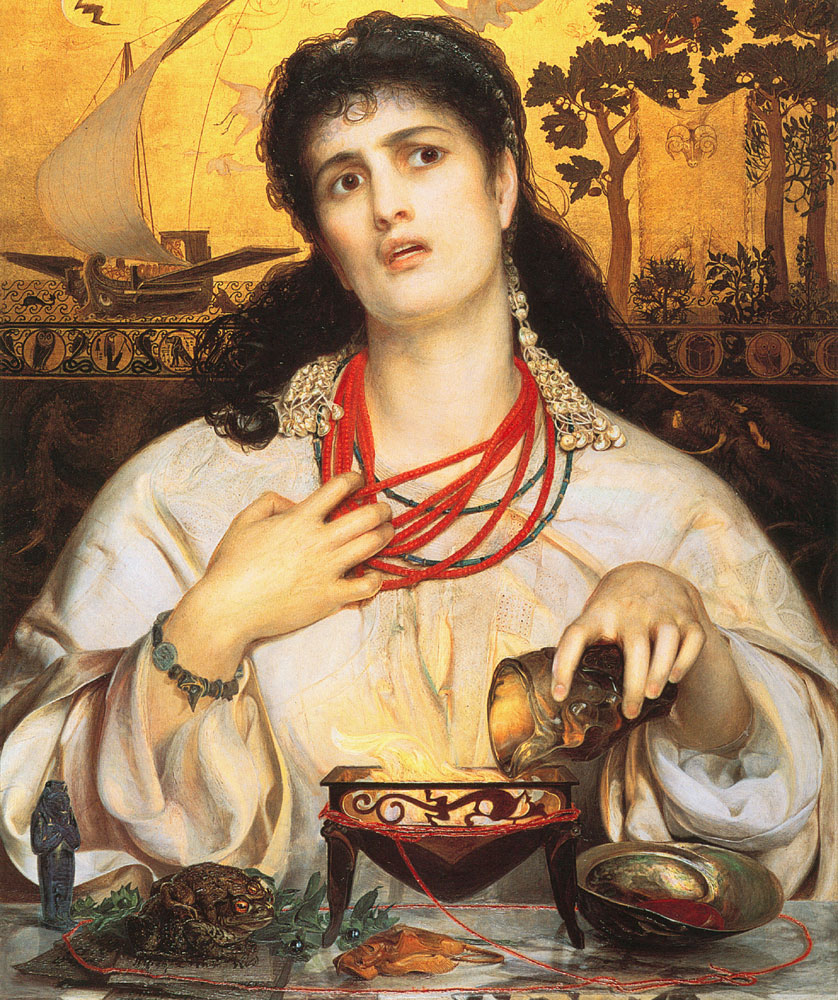
I love this painting of Medea by Anthony Frederick Augustus Sandys (painted 1866). (Pic from Wiki media Commons). She looks somewhat worried as she mixes her magical potion don't you think?  She reminds me of an American actress who appears regularly in tv cop series but I can't think of her name.

THE ARGONAUTS 77. -  THE MAGIC ARTS

a)Hís rébus cógnitís Médéa rem aegré tulit, et régní cupiditáte adducta mortem régí per dolum ínferre cónstituit. Hóc cónstitútó ad fíliás régis vénit atque ita locúta est: "Vidétis patrem vestrum aetáte iam esse cónfectum neque ad labórem régnandí perferendum satis valére. Vultisne eum rúrsus iuvenem fierí?" Tum fíliae régis ita respondérunt: "Num hóc fierí potest? Quis enim umquam é sene iuvenis factus est?" At Médéa respondit: "Mé medicínae summam habére scientiam scítis. Nunc igitur vóbis démónstrábó quó modó haec rés fierí possit." Postquam fínem loquendí fécit, arietem aetáte iam cónfectum interfécit et membra éius in váse aéneó posuit, atque ígní suppositó in aquam herbás quásdam infúdit. Tum, dum aqua effervésceret, carmen magicum cantábat. Mox ariés é váse exsiluit et víribus refectís per agrós currébat.
b)
Some words have been chosen for special consideration and are listed below. For the words not included in this list please refer to the WORDLIST in PAGES TOP RIGHT SIDE BAR. If you need help with points of grammar raised in today's excerpt, consult ESSENTIAL GRAMMAR NOTES also top right side bar.
his rebus cognitis – ablative absolute, ‘these things having been found out’, but we would probably say ‘when Medea found out she ... etc’
rem aegre tulit – rem, accusative singular of the fifth declension noun res meaning, matter, affair, thing, aegre is an adverb ‘badly’ coming before the verb as we expect and tulit third person singular perfect active of the verb fero, ferre, tuli, which has many meanings one of which is  ‘take’, so altogether something like our expression ‘she took it badly’.
regni cupiditate adducta – led by a desire for the kingdom.
mortem regi ... constituit – to make even a gist translation intelligible you have to turn this around, it means ‘death - to the king - through a trick - to bring about - she decided’
filias regis – the daughters (accusative plural of filia) of the king (genitive of rex), or ‘the king’s daughters’.
ita locutus est – this she spoke, ita ‘thus, in this way’, locutus est, third person singular perfect tense active of the deponent verb loquor, ‘she spoke’, together being ‘thus she spoke’ but we would probably say: ‘she said this’.
vestrum – ‘your’, when talking to more than one person, accusative singular masculine adjective agreeing with the masc acc noun patrem.
aetate – ablative of cause from the feminine third declension noun aetas, aetatis, ‘age’, meaning ‘with age, by age’.
ad laborem regnandi perferendum satis valere – for the work of ruling enduring enough being well, with the sense ‘being well enough to endure the work of being ruler’. 
vultisne – the enclitic ne (or add-on) is added to the first word to turn a statement into a question, vultis= you want, vultisne= do you want?.
Num hoc fieri potest? – Num introduces a question which expects a negative answer: hoc fieri potest – literally, ‘this to happen it can’ or ‘this can happen’, so num hoc fieri potest? means something like, ‘Surely this can’t happen?’ or ‘This can’t happen can it?’
e sene – ablative after the preposition e (ex before a vowel) from the adjective and noun senex, senis ‘old, aged’, meaning ‘from being old’, or ‘from being an old man’.
vobis demonstrabo – vobis is dative plural, meaning ‘I will show to you’ but in English we say ‘I will show you’.
quo modo haec fieri possit – in what way this thing may be brought about/may happen’, so we put ‘how this can be done’.
me .habere.. scitis – Accusative Infinitive construction, ‘you know me to have a great deal of knowledge etc.’ but we would probably say ‘You know that I have etc.’
igni supposito – ablative absolute again, meaning ‘having put the fire under’.
in aquam – accusative after in here as it means ‘into’.
herbas quasdam – certain (unspecified) herbs.
e vase – e followed by ablative of vas, vasis, third declension neuter noun, ‘dish, pot’.
viribus refectis – ablative phrase, ‘with his strength renewed’.
per agros – the preposition per ‘through’ takes the accusative, here the acc plural of ager, -i masc second declension noun, meaning therefore ‘through the fields’.
 

c)
Note: This section is not translated into idiomatic English but is intended, together with the notes, to give you the gist of the meaning; you can then come up with your own improved translation.
His rebus cognitis
When these things were found out
Medea rem aegre tulit,
Medea took it badly
et regni cupiditate adducta
and led by a desire to rule
mortem regi per dolum inferre constituit.
she decided to bring about death to the king by a trick
Hoc constituto ad filias regis venit
Having decided this she came to the daughters of the king
atque ita locuta est:
and said this:
"Videtis patrem vestrum
You see your father
aetate iam esse confectum neque
is now worn out with age and is not
ad laborem regnandi perferendum
for carrying on the work of ruling
satis valere.
sufficiently strong.
Vultisne eum rursus iuvenem fieri?"
Do you want to see him become young again?
Tum filiae regis ita responderunt:
Then the daughters of the king answered thus:
"Num hoc fieri potest?
Surely this can’t happen?
Quis enim umquam
For who ever
e sene iuvenis factus est?"
from and old man has been made young?
At Medea respondit:
But Medea answered:
"Me medicinae
I, of medicinal arts
summam habere scientiam scitis.
have the greatest knowledge you know.
Nunc igitur vobis demonstrabo
Now therefore I will show you
quo modo haec res fieri possit."
in what way this thing can happen.
Postquam finem loquendi fecit,
After she finished speaking,
arietem aetate iam confectum
a ram already worn out with age
interfecit et membra eius
she killed and its limbs
in vase aeneo posuit,
she put in a brass pot,
atque igni supposito
and having put a light
in aquam herbas quasdam infudit.
poured into the water certain herbs.
Tum, dum aqua effervesceret,
Then, while the water was bubbling,
carmen magicum cantabat.
she sang a magical song.
Mox aries e vase exsiluit
Soon the ram jumped out of the pot
et viribus refectis per agros currebat.
and with strength renewed he was running through the fields.

d) The following section is for you to copy and translate.

His rebus cognitis
Medea rem aegre tulit,
et regni cupiditate adducta
mortem regi per dolum inferre constituit.
Hoc constituto ad filias regis venit
atque ita locuta est:
"Videtis patrem vestrum
aetate iam esse confectum
neque ad laborem regnandi
perferendum satis valere.
Vultisne eum rursus iuvenem fieri?"
Tum filiae regis ita responderunt:
"Num hoc fieri potest?
Quis enim umquam
e sene iuvenis factus est?"
At Medea respondit:
"Me medicinae
summam habere scientiam scitis.
Nunc igitur vobis demonstrabo
quo modo haec res fieri possit."
Postquam finem loquendi fecit,
arietem aetate iam confectum
interfecit et membra eius
in vase aeneo posuit,
atque igni supposito
in aquam herbas quasdam infudit.
Tum, dum aqua effervesceret,
carmen magicum cantabat.
Mox aries e vase exsiluit
et viribus refectis per agros currebat.

Saturday, 27 October 2012

76. - THE BARGAIN WITH PELIAS


This vase painting depicts Jason bringing the golden fleece to Pelias. (Picture from Wikimedia Commons)
a)Tandem post multa perícula Iásón in eundem locum pervénit unde profectus erat. Tum é náví égressus ad régem Peliam, quí régnum adhúc obtinébat, statim sé contulit, et vellere aureó mónstrátó ab eó postulávit ut régnum sibi tráderétur; Peliás enim pollicitus erat, sí Iásón vellus rettulisset, sé régnum eí tráditúrum. Postquam Iásón quid fierí vellet ostendit, Peliás prímó nihil respondit, sed diú in eádem trístitiá tacitus permánsit; tandem ita locútus est: "Vidés mé aetáte iam esse cónfectum, neque dubium est quín diés suprémus mihi appropinquet. Liceat igitur mihi, dum vívam, hóc régnum obtinére; cum autem tandem décesseró, tú mihi succédés." Hác órátióne adductus Iásón respondit sé id factúrum quod ille rogásset.

  b)
Some words have been chosen for special consideration and are listed below. For the words not included in this list please refer to the WORDLIST in PAGES TOP RIGHT SIDE BAR. If you need help with points of grammar raised in today's excerpt, consult ESSENTIAL GRAMMAR NOTES also top right side bar.

tandem - tandem, adv., at length or last, finally.
multa pericula – accusative case after the preposition post, multa is the adj agreeing with the plural neuter noun pericula ‘many dangers’.
in eundem locum – in denoting motion into is followed by the accusative, here of idem locus making eundem locum ‘the same place’.
unde – adverb, ‘from where’.
profectus erat – pluperfect of the deponent verb proficiscor, proficisci, profectus sum, depart, set out, proceed, meaning therefore ‘he had set out’.
e navi – ablative case after e (ex before a vowel) meaning ‘out of’; notice that navi ends in i because this is an i stem third declension noun.
quid fieri vellet ostendit – means literally: what - to happen - he was wanting - he showed but ‘he made known what he wanted to happen’, gives you a better idea of what it means.
ita locutus est  - literally ‘thus he spoke’, ita being ‘thus, in this way’ and locutus being the perfect third person singular of the deponent verb loquor,  but we would probably say, ‘he said this’.
vides – we have here a verb of sensory perception followed by the accusative infinitive construction ‘you see me to be worn out’ vides me esse confectum’.
aetate – ablative indicating cause ‘by age’, i.e. worn out by age.
appropinquet – third person singular present subjunctive of the first conjugation verb appropinquare. There is no doubt but that (quin) is followed by subjunctive mihi appropinquet – also remember that appropinquare is followed by the dative which is why we have mihi here ‘to me it approaches’.
dies supremus – supremus can mean highest, greatest and also as here ‘last’; he means his last day, i.e. the day of his death is approaching.
liceat – third person present subjunctive, ‘let it be permitted’ or ‘let it be allowed’.
liceat igitur mihi – liceat takes the dative so we have mihi here ‘let it be permitted to me’ and notice that igitur is second (it can never come first in its clause).
dum vivam – ‘while I live’, the present subjunctive is required here, as it means ‘so long as I am alive’, this is a temporal clause of time expectancy.
hoc regnum – We have come across this before, the long o in neuter nominative hoc which is found in the writings of the Latin teachers till about mid-twentieth century. (see GRAMMAR NOTES)
mihi succedes – ‘you will succeed me’. Mihi as succedo takes the dative; succedes is the second person future of the verb succedo -cedere, -cessi, -cessus, ‘go/come under, follow after, succeed’.
c)
Note: This section is not translated into idiomatic English but is intended, together with the notes, to give you the gist of the meaning; you can then come up with your own improved translation.
Tandem post multa pericula
At length, after many dangers,
Iason in eundem locum pervenit
Jason came to the same place
unde profectus erat.
from where he had set out.
Tum e navi egressus
Then when he had left the ship
ad regem Peliam,
to King Pelias
qui regnum adhuc obtinebat,
who still ruled the kingdom
statim se contulit,
at once he made his way,
et vellere aureo monstrato
and when he had showed him the golden fleece
ab eo postulavit
he demanded of him
ut regnum sibi traderetur;
that he hand over the kingdom to him;
Pelias enim pollicitus erat,
for Pelias had promised,
si Iason vellus rettulisset,
if Jason brought back the fleece,
se regnum ei traditurum.
he would give him the kingdom.
Postquam Iason quid fieri vellet ostendit,
After Jason made known what he wanted to happen,
Pelias primo nihil respondit,
Pelias at first replied nothing,
sed diu in eadem tristitia
but for a long time in the same sadness;
tacitus permansit;
remained silent;
tandem ita locutus est:
at last he said this:
"Vides me aetate iam esse confectum,
‘You see me already worn out with age,
neque dubium est
nor can there be any doubt
quin dies supremus mihi appropinquet.
but that my last day approaches.
Liceat igitur mihi,
Allow me therefore,
dum vivam, hoc regnum obtinere;
whilst I live, to rule this kingdom;
cum autem tandem decessero,
when however at length I shall depart life,
tu mihi succedes."
you will succeed me.’
Hac oratione adductus
Persuaded by this speech
Iason respondit se id facturum
Jason answered that he would do
quod ille rogasset.
what he had asked.

d) The following section is for you to copy and translate.
Tandem post multa pericula
Iason in eundem locum pervenit
unde profectus erat.
Tum e navi egressus
ad regem Peliam,
qui regnum adhuc obtinebat,
statim se contulit,
et vellere aureo monstrato
ab eo postulavit
ut regnum sibi traderetur;
Pelias enim pollicitus erat,
si Iason vellus rettulisset,
se regnum ei traditurum.
Postquam Iason quid fieri vellet ostendit,
Pelias primo nihil respondit,
sed diu in eadem tristitia
tacitus permansit; tandem ita locutus est:
"Vides me aetate iam esse confectum,
neque dubium est
quin dies supremus mihi appropinquet.
Liceat igitur mihi,
dum vivam, hoc regnum obtinere;
cum autem tandem decessero,
tu mihi succedes."
Hac oratione adductus
Iason respondit se id facturum
quod ille rogasset.