Total Pageviews

Monday, 5 November 2012

77 - RITCHIE’S FABULAE FACILES TRANSLATION – THE ARGONAUTS 77 – THE MAGIC ARTS

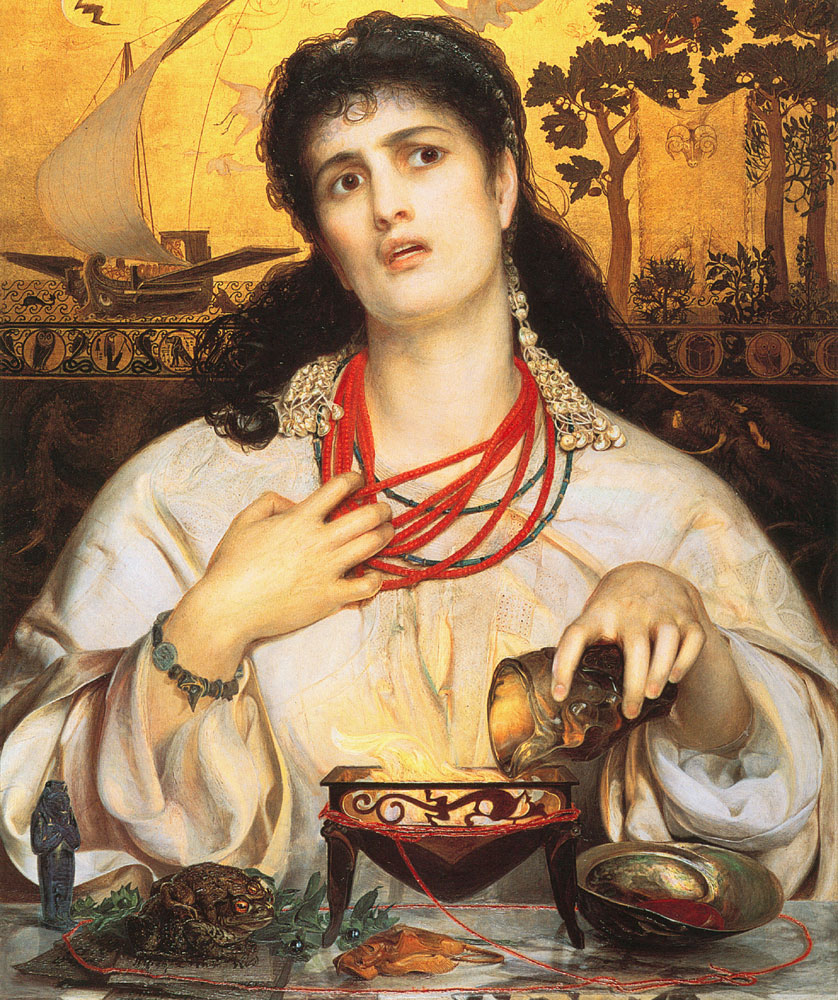
I love this painting of Medea by Anthony Frederick Augustus Sandys (painted 1866). (Pic from Wiki media Commons). She looks somewhat worried as she mixes her magical potion don't you think?  She reminds me of an American actress who appears regularly in tv cop series but I can't think of her name.

THE ARGONAUTS 77. -  THE MAGIC ARTS

a)Hís rébus cógnitís Médéa rem aegré tulit, et régní cupiditáte adducta mortem régí per dolum ínferre cónstituit. Hóc cónstitútó ad fíliás régis vénit atque ita locúta est: "Vidétis patrem vestrum aetáte iam esse cónfectum neque ad labórem régnandí perferendum satis valére. Vultisne eum rúrsus iuvenem fierí?" Tum fíliae régis ita respondérunt: "Num hóc fierí potest? Quis enim umquam é sene iuvenis factus est?" At Médéa respondit: "Mé medicínae summam habére scientiam scítis. Nunc igitur vóbis démónstrábó quó modó haec rés fierí possit." Postquam fínem loquendí fécit, arietem aetáte iam cónfectum interfécit et membra éius in váse aéneó posuit, atque ígní suppositó in aquam herbás quásdam infúdit. Tum, dum aqua effervésceret, carmen magicum cantábat. Mox ariés é váse exsiluit et víribus refectís per agrós currébat.
b)
Some words have been chosen for special consideration and are listed below. For the words not included in this list please refer to the WORDLIST in PAGES TOP RIGHT SIDE BAR. If you need help with points of grammar raised in today's excerpt, consult ESSENTIAL GRAMMAR NOTES also top right side bar.
his rebus cognitis – ablative absolute, ‘these things having been found out’, but we would probably say ‘when Medea found out she ... etc’
rem aegre tulit – rem, accusative singular of the fifth declension noun res meaning, matter, affair, thing, aegre is an adverb ‘badly’ coming before the verb as we expect and tulit third person singular perfect active of the verb fero, ferre, tuli, which has many meanings one of which is  ‘take’, so altogether something like our expression ‘she took it badly’.
regni cupiditate adducta – led by a desire for the kingdom.
mortem regi ... constituit – to make even a gist translation intelligible you have to turn this around, it means ‘death - to the king - through a trick - to bring about - she decided’
filias regis – the daughters (accusative plural of filia) of the king (genitive of rex), or ‘the king’s daughters’.
ita locutus est – this she spoke, ita ‘thus, in this way’, locutus est, third person singular perfect tense active of the deponent verb loquor, ‘she spoke’, together being ‘thus she spoke’ but we would probably say: ‘she said this’.
vestrum – ‘your’, when talking to more than one person, accusative singular masculine adjective agreeing with the masc acc noun patrem.
aetate – ablative of cause from the feminine third declension noun aetas, aetatis, ‘age’, meaning ‘with age, by age’.
ad laborem regnandi perferendum satis valere – for the work of ruling enduring enough being well, with the sense ‘being well enough to endure the work of being ruler’. 
vultisne – the enclitic ne (or add-on) is added to the first word to turn a statement into a question, vultis= you want, vultisne= do you want?.
Num hoc fieri potest? – Num introduces a question which expects a negative answer: hoc fieri potest – literally, ‘this to happen it can’ or ‘this can happen’, so num hoc fieri potest? means something like, ‘Surely this can’t happen?’ or ‘This can’t happen can it?’
e sene – ablative after the preposition e (ex before a vowel) from the adjective and noun senex, senis ‘old, aged’, meaning ‘from being old’, or ‘from being an old man’.
vobis demonstrabo – vobis is dative plural, meaning ‘I will show to you’ but in English we say ‘I will show you’.
quo modo haec fieri possit – in what way this thing may be brought about/may happen’, so we put ‘how this can be done’.
me .habere.. scitis – Accusative Infinitive construction, ‘you know me to have a great deal of knowledge etc.’ but we would probably say ‘You know that I have etc.’
igni supposito – ablative absolute again, meaning ‘having put the fire under’.
in aquam – accusative after in here as it means ‘into’.
herbas quasdam – certain (unspecified) herbs.
e vase – e followed by ablative of vas, vasis, third declension neuter noun, ‘dish, pot’.
viribus refectis – ablative phrase, ‘with his strength renewed’.
per agros – the preposition per ‘through’ takes the accusative, here the acc plural of ager, -i masc second declension noun, meaning therefore ‘through the fields’.
 

c)
Note: This section is not translated into idiomatic English but is intended, together with the notes, to give you the gist of the meaning; you can then come up with your own improved translation.
His rebus cognitis
When these things were found out
Medea rem aegre tulit,
Medea took it badly
et regni cupiditate adducta
and led by a desire to rule
mortem regi per dolum inferre constituit.
she decided to bring about death to the king by a trick
Hoc constituto ad filias regis venit
Having decided this she came to the daughters of the king
atque ita locuta est:
and said this:
"Videtis patrem vestrum
You see your father
aetate iam esse confectum neque
is now worn out with age and is not
ad laborem regnandi perferendum
for carrying on the work of ruling
satis valere.
sufficiently strong.
Vultisne eum rursus iuvenem fieri?"
Do you want to see him become young again?
Tum filiae regis ita responderunt:
Then the daughters of the king answered thus:
"Num hoc fieri potest?
Surely this can’t happen?
Quis enim umquam
For who ever
e sene iuvenis factus est?"
from and old man has been made young?
At Medea respondit:
But Medea answered:
"Me medicinae
I, of medicinal arts
summam habere scientiam scitis.
have the greatest knowledge you know.
Nunc igitur vobis demonstrabo
Now therefore I will show you
quo modo haec res fieri possit."
in what way this thing can happen.
Postquam finem loquendi fecit,
After she finished speaking,
arietem aetate iam confectum
a ram already worn out with age
interfecit et membra eius
she killed and its limbs
in vase aeneo posuit,
she put in a brass pot,
atque igni supposito
and having put a light
in aquam herbas quasdam infudit.
poured into the water certain herbs.
Tum, dum aqua effervesceret,
Then, while the water was bubbling,
carmen magicum cantabat.
she sang a magical song.
Mox aries e vase exsiluit
Soon the ram jumped out of the pot
et viribus refectis per agros currebat.
and with strength renewed he was running through the fields.

d) The following section is for you to copy and translate.

His rebus cognitis
Medea rem aegre tulit,
et regni cupiditate adducta
mortem regi per dolum inferre constituit.
Hoc constituto ad filias regis venit
atque ita locuta est:
"Videtis patrem vestrum
aetate iam esse confectum
neque ad laborem regnandi
perferendum satis valere.
Vultisne eum rursus iuvenem fieri?"
Tum filiae regis ita responderunt:
"Num hoc fieri potest?
Quis enim umquam
e sene iuvenis factus est?"
At Medea respondit:
"Me medicinae
summam habere scientiam scitis.
Nunc igitur vobis demonstrabo
quo modo haec res fieri possit."
Postquam finem loquendi fecit,
arietem aetate iam confectum
interfecit et membra eius
in vase aeneo posuit,
atque igni supposito
in aquam herbas quasdam infudit.
Tum, dum aqua effervesceret,
carmen magicum cantabat.
Mox aries e vase exsiluit
et viribus refectis per agros currebat.

Saturday, 27 October 2012

76. - THE BARGAIN WITH PELIAS


This vase painting depicts Jason bringing the golden fleece to Pelias. (Picture from Wikimedia Commons)
a)Tandem post multa perícula Iásón in eundem locum pervénit unde profectus erat. Tum é náví égressus ad régem Peliam, quí régnum adhúc obtinébat, statim sé contulit, et vellere aureó mónstrátó ab eó postulávit ut régnum sibi tráderétur; Peliás enim pollicitus erat, sí Iásón vellus rettulisset, sé régnum eí tráditúrum. Postquam Iásón quid fierí vellet ostendit, Peliás prímó nihil respondit, sed diú in eádem trístitiá tacitus permánsit; tandem ita locútus est: "Vidés mé aetáte iam esse cónfectum, neque dubium est quín diés suprémus mihi appropinquet. Liceat igitur mihi, dum vívam, hóc régnum obtinére; cum autem tandem décesseró, tú mihi succédés." Hác órátióne adductus Iásón respondit sé id factúrum quod ille rogásset.

  b)
Some words have been chosen for special consideration and are listed below. For the words not included in this list please refer to the WORDLIST in PAGES TOP RIGHT SIDE BAR. If you need help with points of grammar raised in today's excerpt, consult ESSENTIAL GRAMMAR NOTES also top right side bar.

tandem - tandem, adv., at length or last, finally.
multa pericula – accusative case after the preposition post, multa is the adj agreeing with the plural neuter noun pericula ‘many dangers’.
in eundem locum – in denoting motion into is followed by the accusative, here of idem locus making eundem locum ‘the same place’.
unde – adverb, ‘from where’.
profectus erat – pluperfect of the deponent verb proficiscor, proficisci, profectus sum, depart, set out, proceed, meaning therefore ‘he had set out’.
e navi – ablative case after e (ex before a vowel) meaning ‘out of’; notice that navi ends in i because this is an i stem third declension noun.
quid fieri vellet ostendit – means literally: what - to happen - he was wanting - he showed but ‘he made known what he wanted to happen’, gives you a better idea of what it means.
ita locutus est  - literally ‘thus he spoke’, ita being ‘thus, in this way’ and locutus being the perfect third person singular of the deponent verb loquor,  but we would probably say, ‘he said this’.
vides – we have here a verb of sensory perception followed by the accusative infinitive construction ‘you see me to be worn out’ vides me esse confectum’.
aetate – ablative indicating cause ‘by age’, i.e. worn out by age.
appropinquet – third person singular present subjunctive of the first conjugation verb appropinquare. There is no doubt but that (quin) is followed by subjunctive mihi appropinquet – also remember that appropinquare is followed by the dative which is why we have mihi here ‘to me it approaches’.
dies supremus – supremus can mean highest, greatest and also as here ‘last’; he means his last day, i.e. the day of his death is approaching.
liceat – third person present subjunctive, ‘let it be permitted’ or ‘let it be allowed’.
liceat igitur mihi – liceat takes the dative so we have mihi here ‘let it be permitted to me’ and notice that igitur is second (it can never come first in its clause).
dum vivam – ‘while I live’, the present subjunctive is required here, as it means ‘so long as I am alive’, this is a temporal clause of time expectancy.
hoc regnum – We have come across this before, the long o in neuter nominative hoc which is found in the writings of the Latin teachers till about mid-twentieth century. (see GRAMMAR NOTES)
mihi succedes – ‘you will succeed me’. Mihi as succedo takes the dative; succedes is the second person future of the verb succedo -cedere, -cessi, -cessus, ‘go/come under, follow after, succeed’.
c)
Note: This section is not translated into idiomatic English but is intended, together with the notes, to give you the gist of the meaning; you can then come up with your own improved translation.
Tandem post multa pericula
At length, after many dangers,
Iason in eundem locum pervenit
Jason came to the same place
unde profectus erat.
from where he had set out.
Tum e navi egressus
Then when he had left the ship
ad regem Peliam,
to King Pelias
qui regnum adhuc obtinebat,
who still ruled the kingdom
statim se contulit,
at once he made his way,
et vellere aureo monstrato
and when he had showed him the golden fleece
ab eo postulavit
he demanded of him
ut regnum sibi traderetur;
that he hand over the kingdom to him;
Pelias enim pollicitus erat,
for Pelias had promised,
si Iason vellus rettulisset,
if Jason brought back the fleece,
se regnum ei traditurum.
he would give him the kingdom.
Postquam Iason quid fieri vellet ostendit,
After Jason made known what he wanted to happen,
Pelias primo nihil respondit,
Pelias at first replied nothing,
sed diu in eadem tristitia
but for a long time in the same sadness;
tacitus permansit;
remained silent;
tandem ita locutus est:
at last he said this:
"Vides me aetate iam esse confectum,
‘You see me already worn out with age,
neque dubium est
nor can there be any doubt
quin dies supremus mihi appropinquet.
but that my last day approaches.
Liceat igitur mihi,
Allow me therefore,
dum vivam, hoc regnum obtinere;
whilst I live, to rule this kingdom;
cum autem tandem decessero,
when however at length I shall depart life,
tu mihi succedes."
you will succeed me.’
Hac oratione adductus
Persuaded by this speech
Iason respondit se id facturum
Jason answered that he would do
quod ille rogasset.
what he had asked.

d) The following section is for you to copy and translate.
Tandem post multa pericula
Iason in eundem locum pervenit
unde profectus erat.
Tum e navi egressus
ad regem Peliam,
qui regnum adhuc obtinebat,
statim se contulit,
et vellere aureo monstrato
ab eo postulavit
ut regnum sibi traderetur;
Pelias enim pollicitus erat,
si Iason vellus rettulisset,
se regnum ei traditurum.
Postquam Iason quid fieri vellet ostendit,
Pelias primo nihil respondit,
sed diu in eadem tristitia
tacitus permansit; tandem ita locutus est:
"Vides me aetate iam esse confectum,
neque dubium est
quin dies supremus mihi appropinquet.
Liceat igitur mihi,
dum vivam, hoc regnum obtinere;
cum autem tandem decessero,
tu mihi succedes."
Hac oratione adductus
Iason respondit se id facturum
quod ille rogasset.

Tuesday, 16 October 2012

75 RITCHIE’S FABULAE FACILES TRANSLATION – THE ARGONAUTS 75 – A FEARFUL EXPEDIENT

THANK YOU
I want to take the opportunity today to thank the tens of thousands of people from the dozens of countries around the globe who have visited my little Latin blog over the past eighteen months, and especially those who have written to thank me for sharing my Gist Translations and Grammar Notes which they say, have helped them to learn Latin.  I have been amazed and delighted at the diverse, and geographically dispersed, community of people who are interested in learning Latin; to date we number over forty thousand and comprise visitors from Australia, Austria, Belgium, Brazil, Canada, Colombia, Czech Republic, Denmark, Estonia, France, Germany, Greece, Hong Kong, India, Israel, Italy, Japan, Malaysia, Netherlands, New Zealand, Pakistan, Philippines, Portugal, Puerto Rico, Romania, Russia, Singapore, Singapore, Spain, Sweden, Switzerland, Thailand, Turkey, Uganda, Ukraine, United Kingdom, United States; if you are reading this from a country not mentioned, please forgive me but the geographical area spreads rapidly and it is hard to keep track.
My aim is to provide the type of resource that I would have liked to have found on the net when I started learning Latin and this little blog is it.  I believe that interlinear translation is a fast, effective method of vocabulary acquisition, and points of grammar, anomalies etc. can be covered in the accompanying notes. The Gist Translations and Notes are a work in progress and it is my intention to improve on the Posts as my understanding and knowledge of Latin grows.
Thanks again for the encouragement and kind appreciation of the work I offer here. 
Angela
THE ARGONAUTS 75 - A FEARFUL EXPEDIENT


This is a rather lovely picture of Medea - it hardly seems possible that she could be guilty of murder does it? (Painting of Medea is by Evelyn de Morgan 1855 – 1919 from Wiki Commons).
a)Erat in náví Argonautárum fílius quídam régis Aeétae, nómine Absyrtus, quem, ut suprá démónstrávimus, Médéa ex urbe fugiéns sécum abdúxerat. Hunc puerum Médéa interficere cónstituit eó cónsilió, ut membrís éius in mare coniectís cursum Colchórum impedíret; certó enim sciébat Aeétem, cum membra fílí vídisset, nón longius prósecútúrum esse. Neque opínió Médéam fefellit, omnia enim ita événérunt ut spéráverat. Aeétés ubi prímum membra vídit, ad ea conligenda návem tenérí iussit. Dum tamen ea geruntur, Argonautae nón intermissó rémigandí labóre mox é cónspectú hostium auferébantur, neque prius fugere déstitérunt quam ad flúmen Éridanum pervénérunt. Aeétés nihil sibi prófutúrum esse arbitrátus sí longius prógressus esset, animó démissó domum revertit, ut fílí corpus ad sepultúram daret.

b)

Some words have been chosen for special consideration and are listed below. For the words not included in this list please refer to the WORDLIST in PAGES TOP RIGHT SIDE BAR. If you need help with points of grammar raised in today's excerpt, consult ESSENTIAL GRAMMAR NOTES also top right side bar.

erat – this can mean ‘he/she/it was’ and also, as here, ‘there was’.
Argonautarum – remember that this is the plural form of the first declension noun Argonauta which though it looks feminine is masculine.
quidam – ‘a certain’.
regis Aeetae – ‘of King Aeetes’. I expect you can work out why regis ends as it does being the genitive form of the third declension masculine noun rex, regis, but what about Aeetes?  Well this is the genitive of the Greek form of the noun and you will come across Greek nouns quite a lot, especially with regard to names.  The endings for Aeetes are: Nom.ēs; Voc.ē ; Acc. ēn; Gen. ae ; Dat. ae ; Abl. ē
nomine – ablative, ‘by the name’, simply ‘called’.
quem – accusative case singular masculine of quis, quae, quod, ‘whom’. It is accusative as it is the object of abduxerat – ‘whom ... she had led away’.
secum – remember that cum is joined to pronouns so here we have se – herself joined by the preposition cum.
in mare – in, is here followed by the accusative mare of the third declension neuter noun mare, maris, n., sea. to indicate motion into.  If in were indicating place where and not suggesting movement to, but place at rest, it would be ‘in mari’ because where the nominative singular of a third declension noun is the stem plus e, as in mar+e, the ablative singular will end in i, the nominative plural in –ia and the genitive plural in –ium.
fefellit – third person singular perfect tense of the verb fallo, fallere, fefelli, falsus, deceive.
omnia enim – in English ‘for everything’ but notice that in Latin enim comes second.
hunc puerum – this line is literally ‘this boy Medea to kill decided etc’ sounds very clumsy but I hope you get the sense of it through this gist translation and can better phrase it youself.
ubi primum – ‘when at first’, or put more simply ‘as soon as’.
ad ea colligenda – ad with the gerundive often denotes purpose, ‘to (in order to) collect them’ ea here is neuter plural accusative in agreement with the second declension neuter noun membrum, i ‘limb’, plural membra, ‘limbs’).
dum ea geruntur – dum followed by the present in Latin is often translated by the past in English, with the idea of ‘whilst this was going on’ ea being neuter plural to mean ‘these things’.
remigandi – genitive of the gerund of the verb remigo, -are, -avi, atum ‘of rowing’.
auferebantur – third person plural imperfect passive of aufero, ‘they were carried’.
prius .... quam – notice that here the conjugation priusquam has been split into two words but means the same as if it were one word ‘before, until’.
profuturum esse – ‘to be of advantage’ or ‘to be of benefit’ from the verb prosum, prodesse (notice the d before e), profui, profuturus, with sibi dative of advantage
progressus esset – this is the pluperfect subjunctive of the verb progredior, if .. ‘he had advanced’.
ut ... daret – ut here introduces a purpose clause which we know requires the verb to be in the subjunctive, ‘in order that he might give’.
c)
Note: This section is not translated into idiomatic English but is intended, together with the notes, to give you the gist of the meaning; you can then come up with your own improved translation.
Erat in navi Argonautarum
There was in the ship of the Argonauts
filius quidam regis Aeetae,
a certain son of King Aeetes
nomine Absyrtus,
called Absyrtus,
quem, ut supra demonstravimus,
whom, as we have explained above,
Medea ex urbe fugiens secum abduxerat.
Medea, when fleeing out of the city, had led away with her
Hunc puerum Medea interficere constituit eo consilio,
This boy, Medea decided to kill, with this design,
ut membris eius in mare coniectis
that when his limbs were thrown into the sea
cursum Colchorum impediret;
the course of the Colchi she might hinder;
certo enim sciebat Aeetem,
for she knew for sure that Aeetes,
cum membra fili vidisset,
when he saw his son’s limbs
non longius prosecuturum esse.
would no longer pursue
Neque opinio Medeam fefellit,
And the belief did not deceive Medea,
omnia enim ita evenerunt ut speraverat.
for everything turned out just as she had hoped.
Aeetes ubi primum membra vidit,
Aeetes when he first saw the limbs,
ad ea conligenda navem teneri iussit.
ordered that the ship hold course to collect them.
Dum tamen ea geruntur,
While however these things are going on,
Argonautae non intermisso remigandi labore
The Argonauts by not interrupting the work of rowing
mox e conspectu hostium auferebantur,
soon out of sight of the enemy were carried,
neque prius fugere destiterunt quam
and did not stop fleeing until
ad flumen Eridanum pervenerunt.
they reached the river Eridanus.
Aeetes nihil sibi profuturum esse arbitratus
Aeetes thought nothing could be of advantage to him
si longius progressus esset,
if he had longer advanced,
animo demisso domum revertit,
with a dowcast spirit returned homewards,
ut fili corpus ad sepulturam daret.
in order that he might give his son’s body burial.
d) The following section is for you to copy and compose your own translation.
Erat in navi Argonautarum
filius quidam regis Aeetae,
nomine Absyrtus,
quem, ut supra demonstravimus,
Medea ex urbe fugiens secum abduxerat.
Medea had led from the town with her.
Hunc puerum Medea interficere constituit eo consilio,
ut membris eius in mare coniectis
cursum Colchorum impediret;
certo enim sciebat Aeetem,
cum membra fili vidisset,
non longius prosecuturum esse.
Neque opinio Medeam fefellit,
omnia enim ita evenerunt ut speraverat.
Aeetes ubi primum membra vidit,
ad ea conligenda navem teneri iussit.
Dum tamen ea geruntur,
Argonautae non intermisso remigandi labore
mox e conspectu hostium auferebantur,
neque prius fugere destiterunt
quam ad flumen Eridanum pervenerunt.
Aeetes nihil sibi profuturum esse
arbitratus si longius progressus esset,
animo demisso domum revertit,
ut fili corpus ad sepulturam daret.

Monday, 8 October 2012

74 RITCHIE’S FABULAE FACILES TRANSLATION – THE ARGONAUTS 74 – THE PURSUIT

THE ARGONAUTS 74 – THE PURSUIT


a)Hís rébus gestís omnés sine morá návem rúrsus cónscendérunt, et sublátís ancorís prímá vigiliá solvérunt; neque enim satis tútum esse arbitrátí sunt in eó locó manére. At réx Aeétés, quí iam ante inimícó in eós fuerat animó, ubi cógnóvit fíliam suam nón modo ad Argonautás sé recépisse sed etiam ad vellus auferendum auxilium tulisse, hóc dolóre gravius exársit. Návem longam quam celerrimé dédúcí iussit, et mílitibus impositís fugientís ínsecútus est. Argonautae, quí rem in discrímine esse bene sciébant, omnibus víribus rémís contendébant; cum tamen návis quá vehébantur ingentí esset mágnitúdine, nón eádem celeritáte quá Colchí prógredí poterant. Quó factum est ut minimum abesset quín á Colchís sequentibus caperentur, neque enim longius intererat quam quó télum adicí posset. At Médéa cum vídisset quó in locó rés essent, paene omní spé dépositá ínfandum hóc cónsilium cépit.

 b)
Some words have been chosen for special consideration and are listed below. For the words not included in this list please refer to the WORDLIST in PAGES TOP RIGHT SIDE BAR. If you need help with points of grammar raised in today's excerpt, consult ESSENTIAL GRAMMAR NOTES also top right side bar.

his rebus gestis – ablative absolute, ‘when these things had been done’.
omnes – ‘all’ or ‘everybody’.
rursus – adverb, ‘again’.
sublatis ancoris – ‘when the anchor had been weighed’ which means when the anchor had been lifted from the sea prior to departing; the expression comes from the ablative plural of the participle of tollo, tollere, sustuli, sublatus with ablative plural of ancora, ae feminine noun of the first declension.
prima vigilia – ‘at first watch’ our equavalent would probably be ‘at sunset’; the Romans divided the night into four watches, so this would mean that they set off at sunset being the first watch.
neque enim - neque enim, means 'for ... not,' as if simply non enim; Latin often uses neque to connect clauses.
ín eos – in this context the preposition in means ‘against’.
inimico animo - ablative of description, ‘hostile to’.
non modo ... sed etiam – ‘not only but also’.
se recipisse – ‘had taken herself off to’ from the verb se recipere, ‘to betake oneself, withdraw’.  This is again an accusative infinitive construction after ‘he found out’:  he found out/he discovered is followed by accusative ‘her’ and infinitive ‘to have defected’ but of course we would probably say ‘he found out she had defected’
hoc dolore – 'this anger,' i.e. 'anger at this.' .
exarsit – third person singular perfect from the verb exardesco, -ere, -arsi, -arsus, blaze out, be inflamed, rage.
iussit navem longam deduci – notice that iussit ‘he ordered’ third person perfect active from the verb iubere takes the accusative whereas imperare takes the dative. navem longam - Navis longa is the Latin for a warship, sometimes called a war-galley, man-of-war it literally means a long boat.
deduci - the expression navem deducere means ‘to launch a ship’ so we have here an accusative infinitive construction after ‘he ordered’ ... the war ship to be launched (passive infinitive of deducere).
militibus impositis – ablative absolute phrase, ‘when the soldiers had embarked’.
fugientis, used as a noun, 'the fugitives.'
in discrimine – ablative after in, from the third declension noun discrimen, -criminis, n., crisis, peril, danger.
contendebant – third person plural imperfect tense ‘they hastened/hurried’ from the verb contendo, -tendere, -tendi, -tentus, ‘stretch, hasten.’
qua vehebantur – qua is ablative of means ‘by which’ followed by the third person plural imperfect passive ‘they were being borne along’.
quo factus est  ... ut – ‘and so it came to pass’.... ‘that’.
ut minimum abesset quin ... caparentur – literally this means ‘that it was very little far from that ... they were seized’, another way of expressing ‘they were almost seized/ they were nearly seized’. Ut ... abesset is a clause of result, the subject of factum est; quin ... caparentur is a form of subordinate clause with subjunctive verb used after quin.
a Colchis sequentibus – by the Colchians who were following
neque ... posset -'for the distance between them was not greater than a javelin could be thrown.' The clause quo ... posset is a result clause; the distance was not so great that a javelin could not be thrown from one ship to the other.
omni spe deposita – ablative phrase ‘with all hope lost’ or ‘with all hope left behind’.
infandum hoc consilium – the monosyllabic demonstrative adjective is sandwiched between the adjective and noun: ‘this unspeakable plan’ from infandus -a, -um – ‘unspeakable, monstrous’.
c)
Note: This section is not translated into idiomatic English but is intended, together with the notes, to give you the gist of the meaning; you can then come up with your own improved translation.
His rebus gestis
When these things had been done
omnes sine mora
everybody without delay
navem rursus conscenderunt,
made their way again to the ship
et sublatis ancoris
and when the anchors had been weighed
prima vigilia solverunt;
at first watch they set sail
neque enim satis tutum esse arbitrati sunt
for they thought it was not altogether safe
in eo loco manere.
to remain in that place.
At rex Aeetes, qui iam ante
But king Aeetes, who already before now
inimico in eos fuerat animo,
had been hostile against them,
ubi cognovit filiam suam
when he found out that his daughter
non modo ad Argonautas se recepisse
not only had gone over to the Argonauts
sed etiam ad vellus auferendum auxilium tulisse,
but also had given help to steal the fleece
hoc dolore gravius exarsit.
anger at this more seriously inflamed.
Navem longam quam celerrime deduci iussit,
He ordered a war ship be launched as quickly as possible
et militibus impositis
and when the soldiers had embarked
fugientis insecutus est.
he pursued those in flight.
Argonautae, qui rem in discrimine esse
The Argonauts, who, that there was great danger
bene sciebant,
were well aware,
omnibus viribus remis contendebant;
with all their strength took quickly to the oars;
cum tamen navis qua vehebantur
since however the ship by which they being carried
ingenti esset magnitudine,
was of such a huge size,
non eadem celeritate
not with the same speed
qua Colchi progredi poterant.
as the Colchians could they.advance.
Quo factum est ut minimum abesset
With the result that it almost happened
quin a Colchis sequentibus caperentur,
that they were taken by the Colchians following,
neque enim longius intererat
for there was not la greater distance between
quam quo telum adici posset.
but that a spear might be thrown.
At Medea cum vidisset
Now when medea had seen
quo in loco res essent,
how things stood,
paene omni spe deposita
having almost given up all hope
infandum hoc consilium cepit.
hatched this monstrous plan.
d) The following section is for you to copy and compose your own translation.
His rebus gestis
omnes sine mora
navem rursus conscenderunt,
et sublatis ancoris
prima vigilia solverunt;
neque enim satis tutum esse arbitrati sunt
in eo loco manere.
At rex Aeetes, qui iam ante
inimico in eos fuerat animo,
ubi cognovit filiam suam
non modo ad Argonautas se recepisse
sed etiam ad vellus auferendum auxilium tulisse,
hoc dolore gravius exarsit.
Navem longam quam celerrime deduci iussit,
et militibus impositis
fugientis insecutus est.
Argonautae, qui rem in discrimine esse
bene sciebant,
omnibus viribus remis contendebant;
cum tamen navis qua vehebantur
ingenti esset magnitudine,
non eadem celeritate
qua Colchi progredi poterant.
Quo factum est ut minimum abesset
quin a Colchis sequentibus caperentur,
neque enim longius intererat
quam quo telum adici posset.
At Medea cum vidisset
quo in loco res essent,
paene omni spe deposita
infandum hoc consilium cepit.